

For almost 100 years, during the late C18 through to the mid C19, Shakerland Hall extended to some 265 acres and was farmed by just two farmers. Thomas Richer followed by Thomas Francis, who were related to each other.
Richer Road is named after Thomas Richer. It was formerly known as Wyverstone Road, it is not known at which date this name change happened.

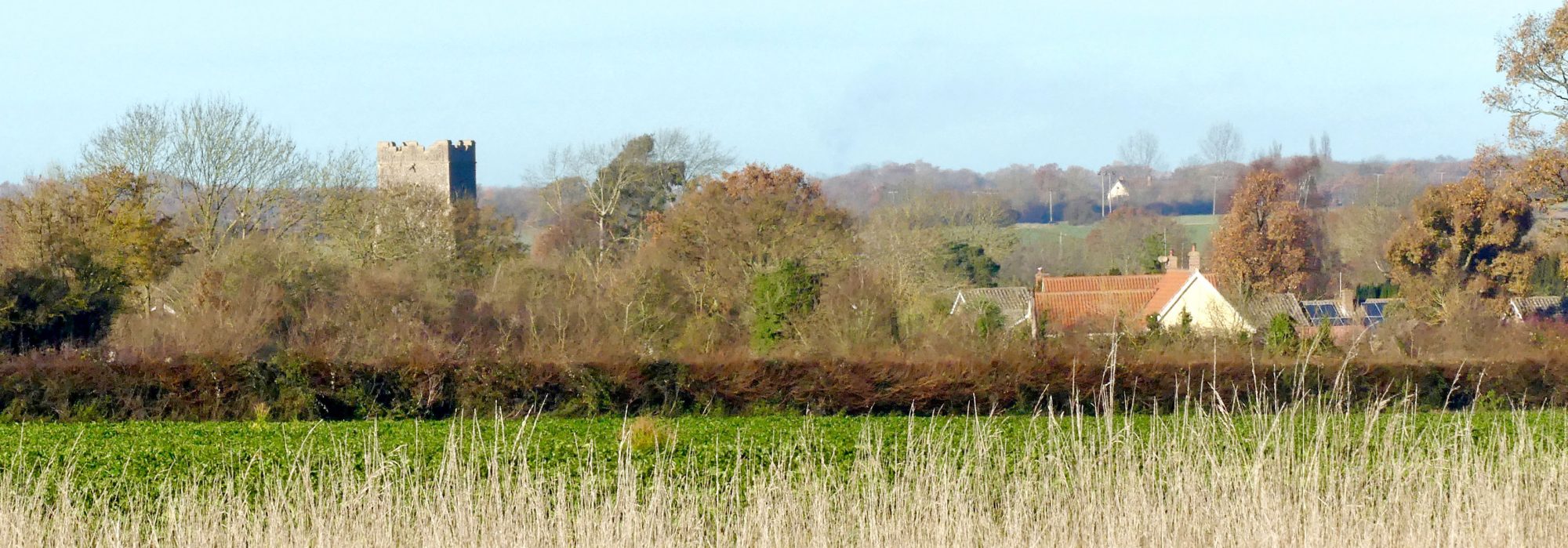
Thomas Richer, who was born in Old Newton (Photo 1) in 1767 gave his name to Richer Road. Before that, it was known as Wyverstone Road. Thomas became a respected figure in Badwell as one of the larger farmers in the parish, even though he was not the landowner, just a tenant farmer.
Sometime before his death in 1842 at the age of 75, the tenancy passed to Thomas Francis who was related to Thomas Richer through his wife Sarah Francis who was Thomas Francis’s sister.


Although Thomas Francis was born in Mendlesham (Photo 2) in 1803 he died in Badwell Ash in 1880 at the age of 77 and both he and his wife Sarah are buried at the East end of St. Mary’s church graveyard, just feet away from the altar. (Photo 3) (Photo 4) To have been considered to be worthy of such a location for his final resting place indicates how he must have been regarded as a person of significant influence within the parish.

Shakerland Hall was one of the three Manors that made up the Parish of Badwell Ash. The other two were Badwell Ash itself and Brushes or Brokeshall which was to the East and which now forms part of Long Thurlow. Thomas Richer and his successor at Shakerland Hall, Thomas Francis were both tenants of Rebecca Clough (1781 – 1846) of Feltwell, Norfolk (Photo 5) who was the owner of The Manor of Shakerland.


How a lady from Feltwell came to be the owner of land in Badwell Ash is a somewhat complex but interesting story. Shakerland Hall was, from early times, owned by Ixworth Priory until the Dissolution of the Monasteries in 1538 by Henry VIII. The manor was then granted by Henry VIII to Richard Codington who owned land in Ewell, Surrey. Henry wanted the land owned by Coddington in Ewell to build Nonesuch Palace, (Photo 6) so he exchanged this land for Shakerland Manor. On Richard’s death it passed to his widow Elizabeth. Both he and Elizabeth are buried in St. Mary’s, Ixworth. (Photo 7) She then granted the manor to a Philip Barrow, who in 1573 sold it to William Masham. He died in 1606, and was succeeded by his son William, and on his death, it passed to his son, Sir William Masham of High Laver, Essex, in 1621.
In 1712, the manor was purchased by Samuel Clough, who, on his death passed it on to his son and heir Robert. Robert died in 1733 and was followed by another Robert whose 2nd son, R. Cyrill Clough, at the time living in Feltwell, the family seat, became lord of the manor and owner of Shakerland Hall in 1764. In 1827, on his death, his daughters Pleasance, Rebecca and Catherine Clough became coheirs and Ladies of the Manor of Shakerland. The Clough family had lived in Feltwell Hall for over 200 years. The Hall was demolished in 1968. (Photo 8)

Rebecca died in 1846 and Pleasance in 1851. They left £28 1s 8d annually to be distributed to the poor of Badwell Ash. The Rebecca Clough Charity is now part of the Badwell Ash Charities, which is an amalgamation of various Charities whose purpose is to support the poor of the parish.
Thomas Richer, who became the tenant of Shakerland Hall, was born in 1767 in Old Newton to Philip and Elizabeth Richer (née Garnham) who had married on the 9th April in 1761. They were married by Licence in St. Mary’s Badwell Ash as on the marriage certificate, it stated that Philip was from Great Ashfield, not Badwell Ash, and Elizabeth was from Ixworth. Philip was born in Ashfield in 1736 and Elizabeth, his wife, was born in Ixworth in 1729. They had 6 children:
- Elizabeth b. 30th June 1761 in Badwell Ash.
- Philip b. 1762 and died on 28th Jan 1813 aged 51. He was a farmer in Old Newton and was buried in Old Newton.
- Mary b. 1765 unmarried and died on 25th Dec 1783.
- Thomas b. 1767 – 1842 our farmer from Shakerland Hall.
- John b.17th July 1768 and died 1st September 1768; less than 2 months old.
- John b. 10th May 1771 and died 17th September 1771; just 4 months old.
Philip Snr’s parents were Thomas Richer, (1696 – 1767) and Bridget Coxedge (1704 – 1756). Thomas is buried in Stowlangtoft. Philip Snr died on 19th January 1799 and is buried in Old Newton.
Thomas Richer Jnr, the subject of this article, married a Sarah Francis on 25th September 1792 in Cotton.
There’s record of a daughter, Sarah, being born in Badwell Ash on the 23rd June 1793, However, there’s no evidence of any other children being born in Badwell Ash to Thomas and Sarah.

However, we know that Thomas and Sarah were living in Shakerland Hall (Photo 9) by 1797 as Thomas placed an advertisement in The Ipswich Journal on January 28th asking whether anyone had lost a bay mare which he had recovered and put in the animal pound at Shakerland Hall.
In the same newspaper Thomas Richer was offering a reward of two pounds ten shillings (£250 today) for any information as to who stole a “Whether Sheep” (a male sheep that has been castrated) from one of his fields at Shakerland Hall.
In March 1801, a reward of £2-10s was offered, this time by the Badwell Ash Association (Link please to The Badwell Ash Association for Prosecuting Persons guilty of Felonies, Burglaries, Larcenies and Thefts – Badwell Ash Heritage) for “the theft of a “Large Shoat”, (a young pig), stolen from Thomas Richer at Shakerland Hall and a further reward of ten guineas (£1,100 today) if the perpetrators were convicted.” The “Badwell Ash Association for Prosecuting Persons guilty of Felonies, Burglaries, Larcenies and Thefts” was formed in 1783 and, with several name changes, continued until 1880. It was formed well before there was a formal police force in West Suffolk in 1844; however, it seems likely that either it ceased functioning due to the increasing success of the West Suffolk Constabulary or, it was amalgamated into the much larger Blackbourne Association for the Prosecution of Felons.
It seems that Thomas joined the Association in 1796 and became its Treasurer in 1813 until his death in 1842.
In 1804, Thomas was acting as the Will Executor for his late father, Philip, who had died in 1799 and was selling his father’s farm in Old Newton. Four years later in 1808, he was also Executor to William Rose’s Will. William Rose lived in Great Ashfield and his fellow Executor was Philip Parker of Parkers Farmhouse in Badwell Ash who had married William Rose’s daughter, Elizabeth.
In August 1811, Thomas was again an Executor of the Will of Thomas Francis Snr. of Mendlesham who had died a few weeks earlier. This is interesting as the farm tenancy at Shakerland Hall was subsequently taken over by Thomas Francis’s grandson, Thomas Francis Snr., shortly before Thomas Richer’s death in 1842.
In September 1812 there was an advertisement in the Ipswich Herald promoting a sale of stock at Shakerland Hall, “The premises of Mr Thomas Richer” including 20 Milch Cows (a dairy cow), all in calf, a handsome black and white 3-year-old bull, a 4-year-old chestnut mare, a boar and 6 young pigs.
On or around 1810, Thomas now aged 43, became joint churchwarden of St. Mary’s church with Robert Rose, William Rose’s son. Three years later in May 1813, these two gentlemen together with John Blencoe, Philip Parker and George Walton, all from Badwell Ash, published an article in the Suffolk Chronicle headed “A Remarkable Case”. The article described a youth of 18, John Hawes, a pauper, who suffered from “A scrophulous disease of the thigh, foot, arm and other parts of his body” but who was miraculously cured by Mr. John Kent of Stanton.
Scrofula is an infection in the lymph nodes in the neck. We now know that scrofula is caused by the same bacteria that causes tuberculosis in the lungs. Treatment today is with antibiotics.
The article goes on to tell us that poor John has had 23 pieces of bone removed from his thigh, arm and foot which must have been excruciatingly painful given the state of the medical profession at the time! However, due to the application of Mr Kent’s “miraculous Botanical Medicines”, poor John Hawes was now perfectly recovered and “now capable of laborious employment for some weeks past at 2s per day for his labour”. In 1827, there’s a further record in the Bury and Suffolk Herald of Mr Hawes surviving for in excess of fourteen years and still capable of laborious employment! This article goes on to promote “Mr Kent’s cures for Scrofulous, Scorbutic and Cancerous Diseases at The Half Moon Inn every Wednesday and at his own house in Stanton”.
By September 1838, it appears that Thomas had vacated Shakerland Hall and was living in Walsham-le Willows as an announcement appeared on the 15th September, in the Ipswich Journal, about a burglary at “…. the dwelling house of Mr. Thomas Richer”. It was reported that the perpetrator had stolen a considerable amount of silver ware, including spoons, a cream jug, a sugar bowl, a silver pocket watch embossed with the name “Philip Richer”, a mourning ring inscribed “Thomas Richer” Snr. and several other gold rings and other items.
Some 3 weeks later on the 3rd October, The Bury and Norwich Post reported that a Joseph Thorsby had been committed to Bury Gaol “for further examination”.
On the 25th March 1840 it was reported in the Bury and Suffolk Herald that “The modern and best part of the Genteel Household Furniture, including china, glass, prints, chaise, Gig harness (A gig is a light, two-wheeled open carriage with large wheels, a forward facing seat, and shafts for a single horse.) and other valuable effects of Mr Thomas Richer was to be sold at Auction on April 3rd “as Thomas was moving house. From the description in the newspaper, it seemed absolutely everything was being sold from four poster beds to curtains, ivory handled knives and even the cucumber frame in the garden!
In the 1841 Census, Thomas and Sarah, now both aged 73 and a maid, Laura Rodwell aged 20, were living at Church House, The Street, in Badwell Ash having moved from Walsham-le-Willows. We believe that Church House has been subsequently divided into two properties, Church House and Corner Cottage. This pair of houses are on the corner of The Street and Wyverstone Road, (now known as Richer Road) opposite Parkers Farmhouse. The Tithe returns of 1839 confirms that Thomas Richer was the owner of this and the adjoining property, now known as Corner Cottage and Church House. (Photo 10) The occupiers were a Thomas Payne and others, the tenants of Thomas Richer.

From the death announcement that appeared in the Bury and Norwich Post in 1842, we know that Thomas was not a well man and had probably evicted his tenants and downsized so he could live in the house, which was opposite his close friend, Philip Parker and his family.
Thomas Richer died on the 28th May 1842 aged 74. An announcement appeared in The Bury and Norwich Post on the 1st June stating “On Saturday last, in his 75th year, after a long affliction highly esteemed and respected by all around him, Mr. Thomas Richer of Badwell Ash”
In the Suffolk Chronicle dated 10th June 1843 an advertisement appeared for the sale of the house in Walsham-le-Willows. The sale included a three-acre field adjoining, an orchard also a double cottage with yards and gardens. The property was to be sold at The Blue Boar Inn in Walsham-le-Willows at the beginning of July.
After Thomas’ death, Sarah continued to live in Church House until her death in March 1847. She was buried on 25th March with her husband in what is now known as The Richer Road Churchyard Extension, which had opened for burials in 1841 as the churchyard itself was full. Unfortunately, today there’s no evidence of their grave as the headstone is missing and despite extensive research carried out by the Badwell Ash History Society in 2022, no evidence of the existence of their headstone could be found.
Thomas Richer’s Will was made on the 12th November 1841. The Executor was Samuel Golding (Solicitor) of Walsham-le-Willows. Thomas Francis the Elder of Mendlesham, Thomas Francis the younger (his son) of Badwell Ash, Farmer and Henry Cross of Stowmarket were Trustees of the Estate and they were to hold the Estate in Trust for his heirs and beneficiaries until Sarah’s death. Thomas’s Estate comprised land and properties in Badwell Ash, Walsham-le-Willows and Old Newton. Thomas Francis the younger was Thomas and Sarah Richer’s nephew and succeeded Thomas Richer as the farmer and occupier of Shakerland Hall.
In the Will, Thomas gave Sarah, his wife, an annual allowance of £100 (£9,000 today) until her death. On her death, the Trustees were ordered to make two bequests, one to the Suffolk General Hospital in Bury St. Edmunds of £400 (worth £44,000 today) and the second as a legacy for the poor of Badwell Ash of £1,200 in Consols in Trust “..the interest of which was to be distributed annually to the poor of the parish in coals”. This sum is worth £72,500 today. The remainder of The Estate was divided into 19 equal parts and divided between all Thomas neices and nephews.
The Badwell Ash Charities
The £1,200 charitable donation was eventually registered with The Charity Commissioners as Charity number: 208594-4 in December 1915 where the object of the charity was descibed as being “For the benefit of the poor of Badwell Ash generally or such deserving and necessitous persons resident therein”
In January 1963, the Thomas Richer Charity together with its bequest was amalgamated with three other local charities in to The Badwell Ash Charities which comprise:

- The Town Trust Estate:
This is of “remote origin” and included a Town House, probably established in the reign of Elizabeth I, to be occupied by the poor. The house, which was on the site of Badwell House (Photo11) disappeared after the creation of the Poor Law Amendment Act of 1832. This established Workhouses for the Poor with our local one being The Stow Workhouse in Stowmarket. The Town Trust also donated the income from 11 acres of land identified in the Tithe Apportionment of 1839 as being:
- Plots 126 and 126A comprising about 1 acre and situated on the north-western side of the road towards Walsham le Willows, known as Lammas meadow. It was occupied by Thomas Francis.
- Plot 29 comprising 4 acres and situated next to the current Mill House off Hunston Road known as Town Pits, It was occupied by Thomas Mudd, the Miller.
- Plot 304A comprising about 6 acres of land and located in Badwell Green off The Green Lane near Badwell Green Farm. It was occupied by James Goodall.
- Plot 17 comprising 0.1 acres. This was The Town House which was situated on what is today, Badwell House opposite The White Horse car park.
All these lands were let at £12. 3s. 6d p.a in 1840 (£1,100 p.a. today), which was applied to church repairs and other ordinary expenses.
Today, none of these “Town Lands” are owned by charity and are all in private ownership.

- Thomas Blackerby’s Gift:
In 1661/2 by the Will of Thomas Blackerby: £1. 4s. p.a (£179 today) paid to the churchwardens and distributed in bread at the church. The Thomas Blackerby Board is on the north side of the Nave in St. Mary’s Church. (Photo 12)
- The Bequest of the Misses Clough:
After the death of Miss Rebecca Clough in 1846, her Estate made a bequest in of £27 p.a.(£2,725 today) for distribution to poor on New Year’s Day.
The Badwell Ash United Charities still distributes money to the poor of the village annually. It has total income today of £567, which is the interest on the monies deposited with The Charity Commission.
Howard Newman
Badwell Ash History Society
September 2025


